
FreezeCheck investigation · Tether freezes
Tether froze the wallet. The money kept moving through a new one: $130M
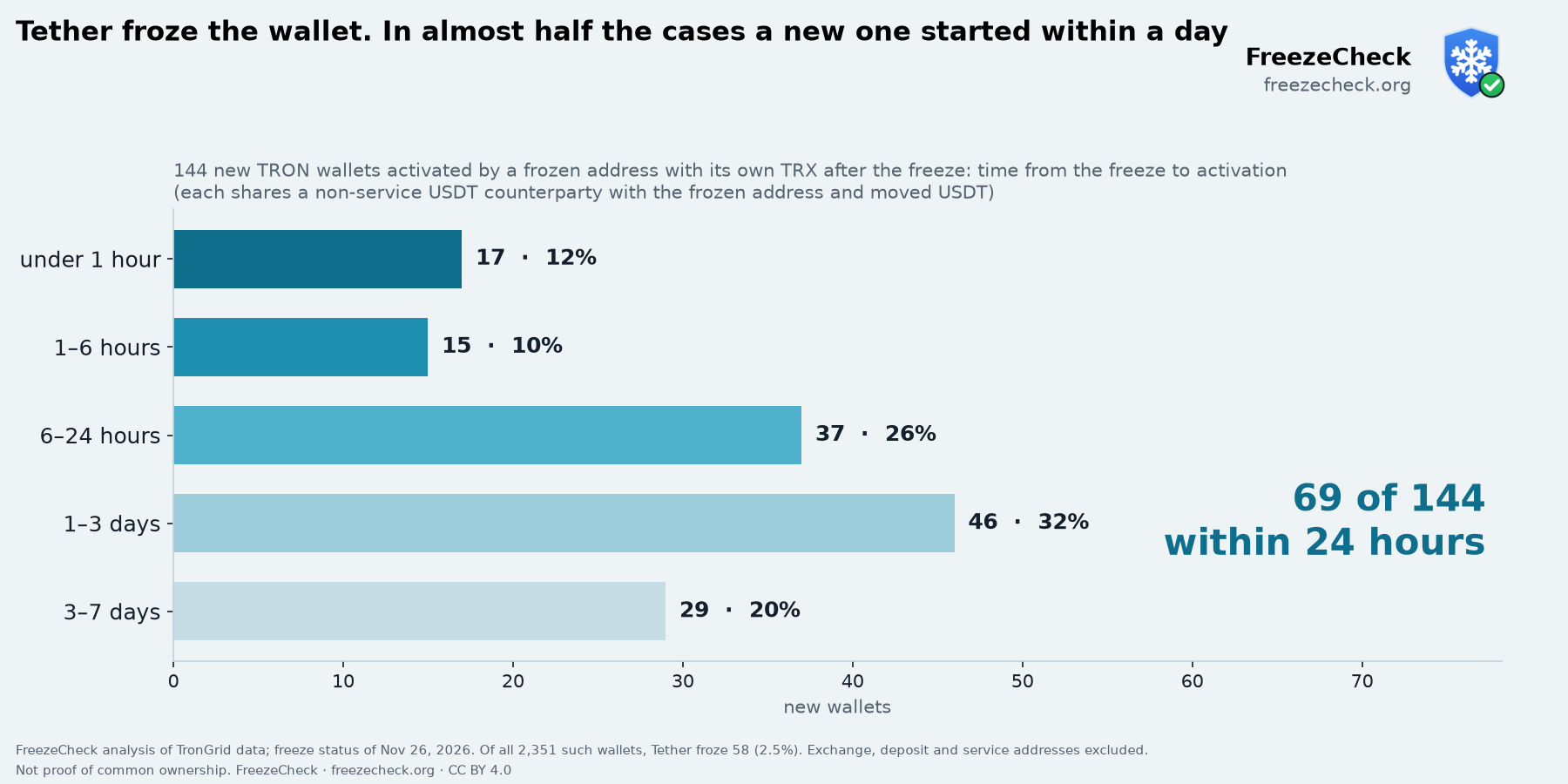
A Tether freeze on TRON locks only the USDT on that one address. The address can still send TRX, and with TRX it can activate new wallets. FreezeCheck checked all 8,281 addresses on Tether’s TRON blacklist. After the freeze, 1,358 of them used their own TRX to activate 2,351 brand-new wallets. We then kept only the new wallets that look like a continuation of the frozen one: activated within 7 days, sharing at least one non-service USDT counterparty with the frozen address, and moving USDT. There are 144 of them, from 117 frozen addresses, and they sent out $130.0 million in USDT. Tether froze 58 of the 2,351 new wallets (2.5%), 34 of them on the same day as the original address. On November 26, 2026, all 144 linked wallets were still not frozen.
A brand-new wallet with no history can be the continuation of a frozen one. Look at who activated it: who sent its very first TRX.
What a freeze does and does not do
When Tether adds a TRON address to its USDT blacklist, USDT on that address can no longer be sent. Nothing else changes. The address keeps its TRX, can stake and vote, can change its keys, and can send TRX to any other address. Sending at least a little TRX to an address that has never been used creates (activates) a new wallet on TRON. We looked for exactly that: new wallets whose very first TRX came from a frozen address, after that address was frozen.
Key findings
- New wallets appear fast. Of the 144 linked new wallets, 17 were activated within an hour of the freeze, 69 within a day, and all within 7 days by definition. The median is 26 hours. Across all 2,351 new wallets, 41 appeared within an hour and 334 within a day.
- More money moved after the freeze than stayed frozen. The 144 linked new wallets sent out $130.0 million in USDT. On their 117 original addresses, $22.9 million is frozen today, and on 24 of them less than 1 USDT. In one case, Tether froze an address on July 7, 2026 at 13:51 UTC with 2,355 USDT on it. Two days and 16 hours later the same address activated a new wallet (TRpDbJ…vhww). That wallet sent out $11.2 million in USDT, 7 of its counterparties are counterparties of the frozen address, and it is not frozen.
- Tether rarely catches the new wallet. Of all 2,351 new wallets, Tether froze 58 (2.5%). In 34 of these 58 cases both addresses were frozen on the same day, that is, together rather than as a follow-up. Of the 2,293 new wallets that were not frozen on November 19, none was frozen in the following week.
- The largest flows are concentrated. The median linked new wallet sent out about $100,800; the 26 largest sent over $1 million each. The top four, $11–14 million each, were checked by hand on November 26: the original addresses are on Tether’s blacklist, the new wallets are not, and the first TRX of each new wallet came from its frozen address.
- It has been going on for years. New wallets activated by frozen addresses appear for freezes from 2023 (116), 2024 (535), 2025 (900) and 2026 so far (660).
What this means for you
- A clean, empty history is not proof of a clean wallet. A wallet created yesterday may be the continuation of a frozen one.
- Check who activated the wallet. In a TRON explorer, open the wallet’s oldest transaction: the first TRX it received. If it came from an address frozen by Tether, treat the wallet with caution. FreezeCheck shows this in the report as “Wallet was activated by an address frozen by Tether”.
- Check before you accept USDT, not after. If the sender’s wallet is frozen later, the USDT you already received is not affected by that freeze, but an exchange may ask questions about where it came from.
Method
Blacklist: 8,281 TRON addresses with an AddedBlackList event of the USDT TRC-20 contract (slice of November 19, 2026); freeze status recounted on November 26, 2026 from the same events. For every frozen address we read its outgoing transactions after the freeze through TronGrid (up to the latest 200 per address) and collected the recipients of TRX. For each recipient we found its activation (the first incoming TRX) and kept it as a new wallet if the activation came from that frozen address after the freeze and the recipient had no transaction before the freeze. We removed recipients labelled as exchanges, exchange deposits or services. The same rule was applied to recipients that are themselves on the blacklist, to count how many new wallets Tether froze. “Linked” new wallets: activated within 7 days of the freeze, sent USDT, and share at least one USDT counterparty with the frozen address that is not an exchange, deposit address or service. USDT sent out is counted from the latest 200 USDT transfers of each new wallet, so for 15 wallets with more transfers it is a lower bound.
Limitations
Ordinary wallets also activate new wallets: in a control check, frozen addresses did this within 24 hours only slightly more often than comparable unfrozen wallets did. A shared counterparty is a link, not proof that the same person controls both wallets, and a new wallet may have been sold, rented or used by someone else. We do not claim who is behind any of these wallets, and we do not claim that any of them is used for crime. New wallets are masked in the text and in the CSV; the original frozen addresses are public in Tether’s blacklist. We only see recipients of the latest 200 outgoing transactions of each frozen address, so the counts are a lower bound. These figures have not been independently reviewed yet.
Data: TRON blockchain (TronGrid), labels from the FreezeCheck database. Questions and corrections: hello@freezecheck.org, @freezecheck_support.