
FreezeCheck research team · Version 1.1 · 2026-11-20 · Snapshot: TRON block 88,163,045
Status: published on 2026-11-20 at https://freezecheck.org/research/frozen-then-shared-en.html. No independent external review has been carried out.
Abstract
Tether can freeze USDT on TRON by adding an address to the token contract's blacklist. A frozen
address keeps its own account permissions, and its owner can still change them. We asked what
happened to the owner permissions of frozen wallets after the freeze. This paper describes one
narrow pattern. One external key, which we call K-1 (TDDCoDCftE4S1j8iqFtuYrcQY8EGtw6bqp),
was added to the owner permission of 40 USDT-frozen wallets. In all 40 the addition came after
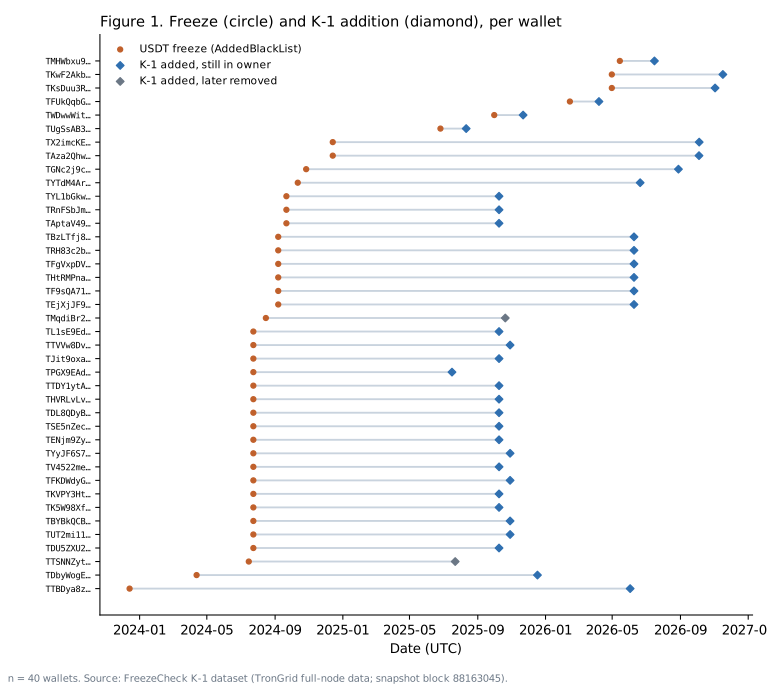
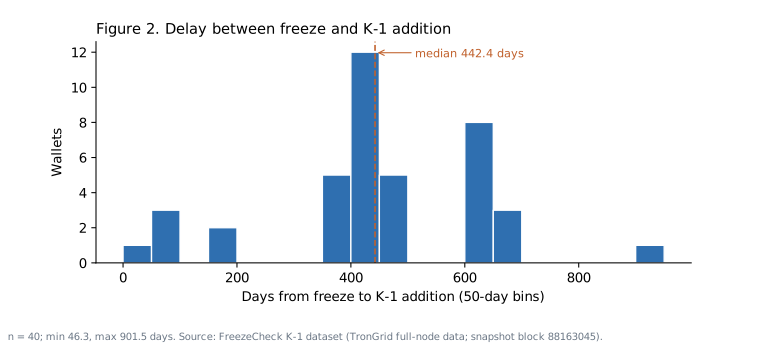
the freeze, 46.3 to 901.5 days later (median 442.4 days). At the snapshot K-1 was still an owner
key in 38 wallets.
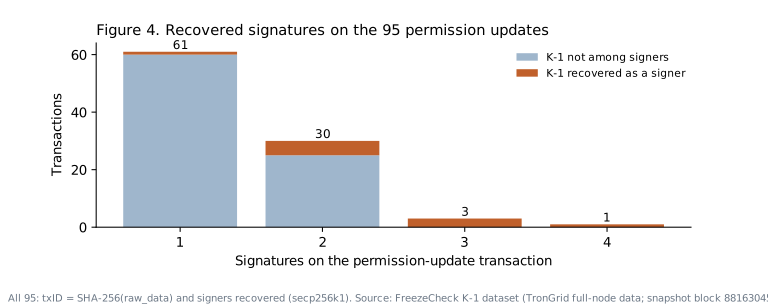
We re-downloaded all 95 permission-update transactions of these 40 wallets. For each one we recomputed the transaction ID and recovered every signer from the secp256k1 signatures with two independent implementations. All 95 matched. K-1 was recovered as a signer in 10 of them, in 8 wallets. It never signed its own addition. The aggregate observed USDT balance of the 38 current wallets was 54,799,048.91 USDT at block 88,163,045. All 40 wallets were blacklisted at that block.
The data show a shared configured signer, added after the freeze, and verified signatures. They do not show who controls K-1 or the wallets, and they do not show common beneficial ownership.
1. Introduction
A TRON account has one owner permission and up to several active permissions. Each
permission is a list of keys with weights and a threshold. A transaction is valid only if the
weights of its signers reach the threshold of the permission it names. The owner permission can do
everything, including AccountPermissionUpdate, the operation that rewrites the permissions
themselves. An account created normally starts with owner 1-of-1: its own address key, weight 1,
threshold 1. [R1][R2]
Freezing USDT works at a different layer. Tether's addBlackList call marks an address in the
USDT contract. From then on the contract rejects every USDT transfer sent from that address:
transfer requires that the sender is not blacklisted, and transferFrom requires the same of the
from address. The recipient is not checked. A frozen address can therefore still receive USDT, and
the tokens it receives are frozen together with the rest of its balance. The account itself is
untouched: it can still change its permissions, receive and spend TRX, and sign transactions.
[R3][R4][R12]
The combination matters. When a frozen wallet is changed so that an outside key must co-sign, the holder of that key has a say in anything the wallet does next. That includes what happens if the freeze is ever lifted. It also changes who can be asked to sign. Earlier work measured shared controller keys across TRON and their overlap with the blacklist, but it could not order the freeze against the permission change (Section 9). This paper does that ordering for one key.
2. Research question
For wallets whose USDT was frozen by Tether, when and how did one shared external key (K-1) enter their owner permissions, who signed those changes, and what can that key do now?
We do not ask who K-1 is, and we do not estimate how common the pattern is across TRON.
3. Dataset and selection
Source of addresses. FreezeCheck keeps the full list of USDT AddedBlackList events on TRON:
8,281 entries up to 2026-11-19, including the USDT contract address itself. For the addresses
that still exist on chain, we read their current permissions and full permission histories.
K-1 came out of that history as the outside key present in the most frozen wallets: 38 at
the snapshot, against 10 for the next most common key.
Inclusion. A wallet is included if K-1 appeared in its owner permission at any point in its verified permission history. That gives 40 wallets: 38 current (K-1 in owner at the snapshot) and 2 former (K-1 later removed).
Period. Freezes from 2023-12-13 to 2026-05-14. K-1 additions from 2025-07-16 to 2026-11-16. Permission history up to 2026-11-19. Balance and blacklist snapshot at block 88,163,045 (2026-11-20 08:28 UTC).
What the sample is not. The 40 wallets are selected by one key. They are not a random or representative sample of frozen wallets, and no rate for the wider population can be derived from them. Other keys of the same kind are outside the scope of this paper. Our earlier work shows that co-keys of K-1 appear in 11 more frozen wallets. Those wallets are not analysed here and are not included in any number below.
Exclusions. Addresses checked by FreezeCheck bot users are never published. None of the 40 wallets, and no address in the public dataset, is on that internal list (0 matches against 113 addresses).
4. Methodology
All data come from public TRON infrastructure: the TronGrid HTTP API, plus full-node
gettransactionbyid for raw transaction bytes. No private data source is used.
- Freeze events. For each wallet we take the
AddedBlackList(address _user)event of the USDT contractTR7NHqjeKQxGTCi8q8ZY4pL8otSzgjLj6tfrom/v1/contracts/{contract}/events. We match_userto the wallet, then record the transaction ID, block and block time. All 40 freeze events were found, and their block times equal the times in our blacklist list to the second. - Permission history. We list each wallet's transactions with
/v1/accounts/{address}/transactionsand keep everyAccountPermissionUpdateContract. We then fetch the raw signed transaction with/wallet/gettransactionbyid. History is complete for all 40 wallets: 95 permission updates. - Transaction integrity. For each update we recompute
txID = SHA-256(raw_data)and compare it with the network's ID (95/95 match). We also check that the contract'sowner_addressis the wallet (95/95) and that the network result isSUCCESS(95/95). - Signer recovery. Each 65-byte signature (r, s, v) is a secp256k1 recoverable signature over
the txID. We recover the public key, hash it with Keccak-256, and take the last 20 bytes with
prefix
0x41as the TRON address. Recovery was done twice, with an independent pure-Python implementation and with thecoincurvelibrary (libsecp256k1). The two agreed on all 134 signatures in the 95 transactions. - Threshold check. We reconstruct the permission in force just before each update, from the
previous update's signed bytes, or the account default for the first one. We then check that
(a) every recovered signer is a key of the named permission, (b) no signer appears twice, and
(c) the summed weight reaches the threshold. All 95 updates used the owner permission
(
Permission_id 0) and all passed. The network would reject a transaction that failed this check, so this step tests our reconstruction, not K-1. - State after each update. We decode the new owner and active permissions, including operation
masks, from the signed
AccountPermissionUpdateContractbytes. - Current state. We read
/wallet/getaccountfor all 40 wallets (2026-11-19, 16:22–16:23 UTC). It matched the state decoded from the last update in 40 of 40 cases. - Ordering. For each wallet, delay = time of the transaction that first put K-1 into owner minus time of the freeze event. Both are block timestamps in UTC.
- Balances. We call USDT
balanceOf(address)andgetBlackListStatus(address)withtriggerconstantcontracton the latest block. We record the block height before (88,163,045) and after (88,163,063) the 80 calls. Balances are in USDT (6 decimals). Each wallet is counted once. The same query on 2026-11-19 gave the same total to the cent. - Fee funding. We list incoming TRX in the 7 days before each K-1 addition from the same API. A permission update costs about 100 TRX, burned from the wallet's own balance.
The scripts are published with the dataset (Section 11).
5. Findings
5.1 Summary
| Measure | Value |
|---|---|
| Wallets with K-1 in owner, ever | 40 |
| Wallets with K-1 in owner at snapshot | 38 (2 former) |
| K-1 added after the freeze | 40 of 40 |
| Delay from freeze to K-1 addition | 46.3 – 901.5 days, median 442.4 |
| Permission updates of the 40 wallets | 95 (94 after freeze, 1 before) |
| txID recomputed / signers recovered / threshold met | 95 / 95 / 95 |
| Signatures recovered | 134, two implementations in agreement |
| Updates with K-1 recovered as a signer | 10, in 8 wallets |
| K-1 signed its own addition | 0 of 40 |
| Blacklisted at snapshot | 40 of 40 |
| Aggregate observed USDT balance, 38 current wallets | 54,799,048.91 USDT (block 88,163,045) |
5.2 A shared configured signer
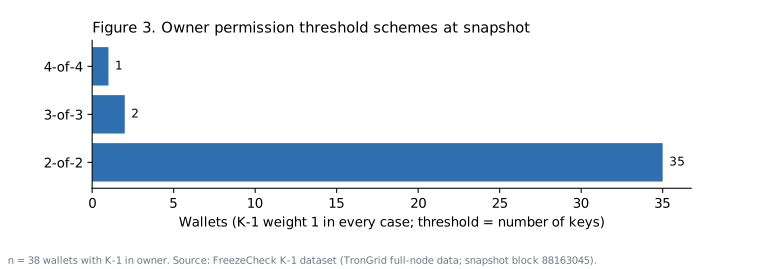
K-1 is a plain address: owner 1-of-1 and default active, and it has never changed its own permissions. At the snapshot it was an owner key with weight 1 in 38 wallets. In every one of them the threshold equals the number of keys:
- 2-of-2 in 35 wallets (the wallet's own key and K-1);
- 3-of-3 in 2 wallets;
- 4-of-4 in 1 wallet.
K-1 was also in the active permission of 37 of the 38. There were no weighted schemes in any interval of the history.
5.3 Post-freeze timing
Every one of the 40 additions came after the freeze event: at least 46.3 days and at most 901.5 days later, median 442.4 days (Figures 1 and 2). The additions came in batches. 14 wallets got K-1 on 2025-10-09, 13 of them between 06:04 and 06:44 UTC, and the latest additions were on 2026-11-02 and 2026-11-16. One of the 95 updates predates its wallet's freeze (2024-12-08, freeze 2024-12-13); it does not involve K-1.
5.4 Who signed the additions
All 40 additions were signed only by keys that were already in the wallet's owner permission:
- 37 by the wallet's own address key alone;
- 2 by the two keys of an existing 2-of-2;
- 1 by a different key that was then the sole owner key.
K-1 did not sign any of its own additions. In 11 wallets the K-1 addition was not the first change after the freeze.
5.5 Cryptographic evidence for K-1 as a signer
K-1 was recovered as a signer in 10 of the 95 updates, in 8 wallets, between 2025-07-18 and 2026-10-04 (Figure 4; full list in Table A2). Nine of these ten carry several signatures: the wallet's key and K-1 signed the same bytes. Their expiration was set about 24 hours after the timestamp. The tenth is the single-signature case described in Section 6.
A recovered signature shows that the holder of the K-1 private key signed that transaction. It does not show who that holder is.
5.6 Balance observations
At block 88,163,045 all 40 wallets were blacklisted. The aggregate observed USDT balance across
the 38 current wallets was 54,799,048.91 USDT, on 37 non-zero wallets. The two former wallets
held a further 6,013,694.36 USDT and are not part of that figure. One current wallet
(TWDwwWitHBjcc9gy8eSTQZiDU9WmjajuY1) shows 0. Its 900,259.71 USDT was destroyed by Tether on
2026-02-24, after K-1 was added (tx 92d81508971ee93144fc25978a6fd753e5d556ee55c153ef28393838cfa49633).
This sum is an observed balance of frozen tokens. It is not stolen funds, not a loss, and not money under one party's control. K-1 cannot move it. No current configuration lets K-1 act alone. The USDT contract also rejects transfers from a blacklisted address, whoever signs.
5.7 Fee funding
The fee observations come from the 7 days before each addition:
- 17 wallets received TRX from the same address,
TVud6AQ4nMQsVXUm4CvPQQ8Ygj9LUyhHyV. Thirteen were funded on 2025-10-08 between 08:53 and 09:07 UTC, about 21 hours before their K-1 additions on 2025-10-09. Four were funded on 2025-10-28/29 and had K-1 added on 2025-10-29. - 6 wallets received TRX from
TBn1BwNUcXVBz9TEYmzW4z9jPNF3tXZ638, 5–30 minutes before their additions on 2026-06-09. - 9 wallets each had a different funder.
- 8 wallets received no TRX (1 TRX or more) in that window and paid from their existing balance.
Neither funding address has a label in our data. Who operates them is not established.
6. Case study: K-1
What K-1 is in this study. K-1 is an address, TDDCoDCftE4S1j8iqFtuYrcQY8EGtw6bqp, that
appears as an owner key in 40 frozen wallets. It has 30 transactions of its own (TRX and TRC-10,
no TRC-20), and it never changed its own permissions.
When it arrived. 2025-07-16 to 2026-11-16, in every case after the freeze.
What it can do. At the snapshot, in all 38 current wallets, K-1 has weight 1 under a threshold
of 2, 3 or 4. Alone it cannot change permissions, move TRX or call the USDT contract in any of
them. Its signature is required for any owner action, and in 37 wallets for any active action
too. The exception is TEjXjJF9Yr8mBcwXD2yGDFCyjBD7A8tZKa. Its active permission is 1-of-1 with
the wallet's own key, so that key can transfer TRX and call contracts without K-1. There K-1 only
blocks permission changes.
When it could act alone. In one former wallet, TTSNNZyt1bX8b5zHaV4LKVenqvUTZEhbmi, owner and
active were 1-of-2 [own key, K-1] from 2025-07-22 07:52 to 2025-07-24 02:44 UTC, about 43 hours.
During that window K-1 alone, with a single signature, raised the threshold to 2-of-2. No funds
moved. On 2026-05-29 the wallet's key and K-1 jointly removed K-1. A different co-key was added
that day.
Where its signatures were recovered. 10 updates in 8 wallets (Table A2).
What can be concluded.
- One key was added, after the freeze, to the owner permission of 40 frozen wallets.
- In each case the addition was signed by keys the wallet already had.
- The same key later co-signed 10 updates.
- Several wallets in a batch were funded by the same address shortly before the change.
What cannot be concluded.
- Who holds K-1, or whether one person or several hold it.
- Whether the wallets have a common owner.
- Why the key was added.
- Whether anyone benefits economically.
A shared key is not proof of a shared owner. The keys were not shown to be held by different people either.
7. Interpretation
The data fit several explanations. We do not choose between them.
- Custody or co-signing service. Holders of frozen wallets hand a co-signing role to a service, for example in the hope of an unfreeze or as part of a dispute or recovery process. The batches and the shared fee payer fit a service that pays fees for its clients.
- Shared operational infrastructure. One operator controls many frozen wallets and manages them with one tool. The shared fee payer fits this too.
- Third-party signing arrangement. A key holder collects co-signing rights over frozen balances in case they are ever released. The holder's motive cannot be seen on chain.
- Coordinated permission management after compromise. The owner keys were copied or stolen, and the copier added K-1. A signature by the wallet's own key does not tell us whether the owner or someone with a copy signed it. We cannot rule this out.
- Other. A recovery or "unfreeze" service, legitimate or not, acting on many clients' behalf. Unfreeze scams aimed at holders of frozen USDT have been reported [R10].
What the data do rule out is narrower. K-1 was not added before the freeze. It did not add itself. It cannot move USDT out of a blacklisted wallet.
8. Limitations
- Selection. The 40 wallets are defined by one key. They are not a representative sample of frozen wallets, and no prevalence claim follows from them.
- Attribution. On-chain data identify keys, not people. Nothing here establishes the identity of K-1, its holder's role, or beneficial ownership of any wallet.
- Control. "K-1 must co-sign" describes the permission rules, not who in practice decides. A key can be shared, sold, copied or lost.
- Time slices. Permissions are as of 2026-11-19 16:23 UTC, and balances and blacklist status as of block 88,163,045. Both can change.
- Search scope. TRON offers no public reverse index from key to accounts. Whether K-1 sits in accounts we did not check is unknown. It was not found in 4,049 unfrozen neighbouring accounts we checked, but that search is not exhaustive.
- Fee funding. Only a 7-day window before each addition was examined, and the funders are unidentified.
- Review. The analysis was re-run by a second, separate internal reviewer with its own code. No independent external review has been carried out.
9. Related work
- Bitquery, "TRON · Permission Layer" (data to 2026-08-10, updated 2026-10-20) [R5].
- It reports that "3,481 controller keys hold signing power over more than one account each", and that "271 of them, holding $343.5M, are on Tether's blacklist".
- It notes that "the label set carries no timestamps, so we cannot order the freeze against the permission change".
- Shared signers on TRON, and their overlap with frozen wallets, are therefore not new.
- AMLBot via Cointelegraph (2025-01-21) [R6]. It reported over 14,500 TRON addresses at risk of silent takeover through permission updates. It counted 2,130 wallets compromised this way in Q4 2024. Permission changes as an attack and control vector on TRON are documented.
- BlockSec.
- "Following the Frozen" (2025-07-11) [R7] and "$1.26 Billion Frozen" (2026-01-30) [R8] analyse the blacklisting itself: who is frozen, when, and what balances were left.
- "Tether destroyBlackFunds: Burn & Reissue Explained" (2026-07-26) [R9] describes the burn mechanism behind the zero balance in Section 5.6.
- "How to Unfreeze USDT" (2026-07-26) [R10] warns of scams aimed at frozen-wallet holders.
- These works do not examine owner-permission changes after the freeze.
- AMLBot, "Tether Freeze Gap…" (2025-05-15) [R11]. It concerns the window between freeze proposal and execution, before the freeze. The present paper looks at the period after it.
What this paper adds.
- A narrow, fully ordered case: freeze event versus permission change, per wallet, with transaction IDs.
- Signer recovery for every update, done independently twice.
- An exact statement of what the shared key can and cannot do at the snapshot.
This is a new sample and a new ordering, built from known methods. We do not claim to be the first to observe shared signers, permission changes or frozen-wallet infrastructure on TRON.
10. Conclusion
One external key, K-1, was added to the owner permission of 40 USDT-frozen TRON wallets, in every case after the freeze. The additions were signed by the wallets' existing keys, often in batches and with a shared fee payer. K-1 later co-signed 10 updates. At the snapshot K-1 is a required co-signer in 38 wallets that together hold 54,799,048.91 USDT in frozen tokens. It cannot act alone in any of them, and it cannot move blacklisted USDT at all.
Freezing a token balance leaves the account's permissions open to change. Exchanges, investigators and issuers looking at a frozen wallet should look at its permission history as well as its balance. Who holds K-1, why it was added and whether the wallets share an owner remain unknown. Two directions for further work follow from this: the other shared keys over frozen wallets, and the funding addresses.
11. Reproducibility and data availability
Public files (publication/final/):
- this paper (EN, RU, PDF);
K1_PUBLIC_DATASET.csv— 40 wallets with freeze and addition transaction IDs, timings, permissions and balances at the snapshot;K1_PUBLIC_DATASET.json— the same, plus all 95 permission updates with recovered signers;K1_METHODOLOGY.md,K1_DATA_DICTIONARY.md,K1_SOURCE_REGISTER.md,K1_REPRODUCIBILITY.md;- the figure files and
data/(freeze events, snapshot readings, summary numbers); scripts/;MANIFEST.sha256.
Public scripts.
k1_verify_signatures.pywithcrypto_a.py— re-downloads the 95 updates, recomputes the txIDs and recovers the signers;k1_check_chain.py— freeze events, order, blacklist status, and the blacklist rule by simulation;k1_render.py— appendix tables, HTML, PDF and the automatic EN/RU number check.
What stays internal. Three things are not part of the public package:
- the raw API responses;
- the reviewer tables and scripts that decoded the full permission histories and built the dataset;
- the list of addresses checked by FreezeCheck users, which is private by policy.
K1_REPRODUCIBILITY.md lists exactly which checks run from the package and which need these
tables. All inputs are public TRON data, and no secret or API key is needed.
References
- [R1] TRON Developers, "Account Permission Management". https://developers.tron.network/docs/multi-signature
- [R2] java-tron,
AccountPermissionUpdateActuator.java(commit 4e8389f). https://github.com/tronprotocol/java-tron/blob/4e8389f159d0782f1ebcd9dab2fd88388c0e6fe9/actuator/src/main/java/org/tron/core/actuator/AccountPermissionUpdateActuator.java - [R3] Tether, "Tether Introduces New Policy to Strengthen Ecosystem Security". https://tether.io/news/tether-introduces-new-policy-to-strengthen-ecosystem-security/
- [R4] USDT TRC-20 contract on Tronscan. https://tronscan.org/#/token20/TR7NHqjeKQxGTCi8q8ZY4pL8otSzgjLj6t
- [R5] Bitquery, "TRON · Permission Layer". https://bitquery.io/investigations/tron-permission-changes
- [R6] Cointelegraph Magazine, "Over 14,500 TRON addresses at risk of silent hijacking" (AMLBot data), 2025-01-21. https://cointelegraph.com/magazine/tron-addresses-risk-silent-hijacking
- [R7] BlockSec, "Following the Frozen: An On-Chain Analysis of USDT Blacklisting and Its Links to Terrorist Financing", 2025-07-11. https://blocksec.com/blog/following-the-frozen-an-on-chain-analysis-of-usdt-blacklisting-and-its-links-to-terrorist-financing
- [R8] BlockSec, "$1.26 Billion Frozen: USDT Blacklisting on Ethereum and Tron in 2025", 2026-01-30. https://blocksec.com/blog/1-26-billion-frozen-usdt-blacklisting-on-ethereum-and-tron-in-2025
- [R9] BlockSec, "Tether destroyBlackFunds: Burn & Reissue Explained", 2026-07-26. https://blocksec.com/blog/destroyblackfunds-tether-mechanic-explained
- [R10] BlockSec, "How to Unfreeze USDT", 2026-07-26. https://blocksec.com/blog/how-to-unfreeze-usdt-address
- [R11] AMLBot, "Tether Freeze Gap Becomes Laundering Loophole for Criminals", 2025-05-15. https://blog.amlbot.com/tether-freeze-gap-becomes-laundering-loophole-for-criminals-an-analytical-report/
- [R12] TetherToken.sol, verified source code of the USDT TRC-20 contract (Tronscan: "Source Code Verified (Perfect match)", solidity 0.4.25), read 2026-11-20:
transfercontainsrequire(!isBlackListed[msg.sender]),transferFromcontainsrequire(!isBlackListed[_from]);deprecated()returned false. https://tronscan.org/#/contract/TR7NHqjeKQxGTCi8q8ZY4pL8otSzgjLj6t/code
Appendix A. Evidence tables
Table A1. The 40 wallets: freeze, K-1 addition and state at the snapshot (block 88,163,045). Source: K1_PUBLIC_DATASET.csv.
| # | Wallet | Freeze (UTC) | K-1 added (UTC) | Delay, days | Owner after addition | At snapshot | USDT at snapshot |
|---|---|---|---|---|---|---|---|
| 1 | TTBDya8zvk6WQmHRwgByt6wvSWS3tcBSvw |
2023-12-13 22:21:48 | 2026-06-02 09:28:48 | 901.5 | 2-of-2 | K-1 in owner, 2-of-2 | 468,010.93 |
| 2 | TDbyWogEUCvfkqHcK5YYA6KQoXGRMCLv9C |
2024-04-12 14:32:09 | 2025-12-17 11:11:12 | 613.9 | 2-of-2 | K-1 in owner, 2-of-2 | 1,500,043.21 |
| 3 | TTSNNZyt1bX8b5zHaV4LKVenqvUTZEhbmi |
2024-07-15 14:11:42 | 2025-07-22 07:52:18 | 371.7 | 1-of-2 | former (2-of-2) | 1,013,644.35 |
| 4 | TDU5ZXU2okL3AKeYBuhpFTP1oC9xMuXeYq |
2024-07-23 19:50:36 | 2025-10-09 06:23:09 | 442.4 | 2-of-2 | K-1 in owner, 2-of-2 | 2,322,602.00 |
| 5 | TUT2mi11zNewe4VUDNDwyWmcj7CtYHcySx |
2024-07-23 19:50:39 | 2025-10-29 05:23:45 | 462.4 | 2-of-2 | K-1 in owner, 2-of-2 | 2,334,973.41 |
| 6 | TBYBkQCBNWaAQkbhZG69Ee8xnZ8Cmk7o8K |
2024-07-23 19:50:51 | 2025-10-29 04:08:39 | 462.4 | 2-of-2 | K-1 in owner, 2-of-2 | 2,200,098.00 |
| 7 | TK5W98XfxE1yuaH5iEbpPio7qgGrCqBfoy |
2024-07-23 19:50:54 | 2025-10-09 06:25:18 | 442.4 | 2-of-2 | K-1 in owner, 2-of-2 | 2,100,104.00 |
| 8 | TKVPY3Ht9hDrQc9iaFD895cDBj7hrjUB7C |
2024-07-23 19:50:57 | 2025-10-09 06:41:03 | 442.4 | 2-of-2 | K-1 in owner, 2-of-2 | 2,200,089.00 |
| 9 | TFKDWdyGKLukoKytCryfhJetVvedNNtAT2 |
2024-07-23 19:51:00 | 2025-10-29 04:18:42 | 462.4 | 2-of-2 | K-1 in owner, 2-of-2 | 2,400,102.00 |
| 10 | TV4522meaQDMmkiVJ2v1gBzcoBMqM9UxdV |
2024-07-23 19:51:09 | 2025-10-09 08:33:54 | 442.5 | 3-of-3 | K-1 in owner, 3-of-3 | 2,200,101.00 |
| 11 | TYyJF6S7Q9znNUrzb8Bpp5CvjdGALyYSZo |
2024-07-23 19:51:09 | 2025-10-29 04:12:21 | 462.4 | 2-of-2 | K-1 in owner, 2-of-2 | 2,230,088.00 |
| 12 | TENjm9Zyn4McrqQmLzhMvNNX6oFj85tAoW |
2024-07-23 19:51:12 | 2025-10-09 06:28:00 | 442.4 | 2-of-2 | K-1 in owner, 2-of-2 | 2,149,097.00 |
| 13 | TSE5nZecBdxjXovBdGueY9DYetueSVQahE |
2024-07-23 19:51:15 | 2025-10-09 06:04:48 | 442.4 | 2-of-2 | K-1 in owner, 2-of-2 | 2,346,400.00 |
| 14 | TDL8QDyBkgwYeaz1yf263qULPopiX6K9yq |
2024-07-23 19:51:18 | 2025-10-09 06:28:00 | 442.4 | 2-of-2 | K-1 in owner, 2-of-2 | 2,278,502.00 |
| 15 | THVRLvLvXAZKDts9LxC1XynEzSdFPoTKue |
2024-07-23 19:51:21 | 2025-10-09 06:04:45 | 442.4 | 2-of-2 | K-1 in owner, 2-of-2 | 2,020,538.00 |
| 16 | TTDY1ytAJ88GKiJNR1qCTGug85VqYXAjZR |
2024-07-23 19:51:21 | 2025-10-09 06:17:42 | 442.4 | 2-of-2 | K-1 in owner, 2-of-2 | 2,100,101.00 |
| 17 | TPGX9EAdsuEfrxhaXiFNi6XYCsZTHALz98 |
2024-07-23 19:51:24 | 2025-07-16 13:00:06 | 357.7 | 3-of-3 | K-1 in owner, 3-of-3 | 2,118,490.00 |
| 18 | TJit9oxaNWYNCxfw5Psf1Q9NmSCsv9ASRo |
2024-07-23 19:51:27 | 2025-10-09 06:33:42 | 442.4 | 2-of-2 | K-1 in owner, 2-of-2 | 2,290,800.00 |
| 19 | TTVVw8DvQ8HFYqqVd399AyGyDp8U36VATV |
2024-07-23 19:51:33 | 2025-10-29 04:15:42 | 462.4 | 2-of-2 | K-1 in owner, 2-of-2 | 2,302,980.00 |
| 20 | TL1sE9EdfVZ57LPftXmzJSGDQ7KC6o9Zkj |
2024-07-23 19:51:36 | 2025-10-09 06:38:57 | 442.4 | 2-of-2 | K-1 in owner, 2-of-2 | 2,309,108.00 |
| 21 | TMqdiBr2ExrKQpCysR9gGYBhzdVfCPHGYM |
2024-08-15 08:21:48 | 2025-10-20 12:43:21 | 431.2 | 3-of-3 | former (3-of-3) | 5,000,050.01 |
| 22 | TEjXjJF9Yr8mBcwXD2yGDFCyjBD7A8tZKa |
2024-09-06 15:01:09 | 2026-06-09 07:15:33 | 640.7 | 2-of-2 | K-1 in owner, 2-of-2 | 111,837.52 |
| 23 | TF9sQA71jifU2U2Qcs6n9wNVfodDS8HXYM |
2024-09-06 15:01:18 | 2026-06-09 07:37:54 | 640.7 | 2-of-2 | K-1 in owner, 2-of-2 | 112,301.41 |
| 24 | THtRMPna3S5EaKWdGxLp1mZf1fTPb3suQk |
2024-09-06 15:01:36 | 2026-06-09 07:40:30 | 640.7 | 2-of-2 | K-1 in owner, 2-of-2 | 113,531.26 |
| 25 | TFgVxpDVPRhgaNdKcCES1o6WHsXczCb3it |
2024-09-06 15:01:54 | 2026-06-09 07:38:51 | 640.7 | 2-of-2 | K-1 in owner, 2-of-2 | 113,321.98 |
| 26 | TRH83c2byegtwshxpkKRHXtFiqxMB5Einj |
2024-09-06 15:02:21 | 2026-06-09 07:39:36 | 640.7 | 2-of-2 | K-1 in owner, 2-of-2 | 113,606.58 |
| 27 | TBzLTfj8k8Jdr7rVsWzkNooKPSUiq7Z4hF |
2024-09-06 15:02:39 | 2026-06-09 07:36:51 | 640.7 | 2-of-2 | K-1 in owner, 2-of-2 | 112,851.96 |
| 28 | TAptaV49xGV3eTE4epFwuqZjMmp6xZfaiE |
2024-09-21 07:28:42 | 2025-10-09 06:10:54 | 382.9 | 2-of-2 | K-1 in owner, 2-of-2 | 1,750,000.00 |
| 29 | TRnFSbJmAnLBo43fkCwnyKJdHgAYeUJSNQ |
2024-09-21 07:29:27 | 2025-10-09 06:44:15 | 383.0 | 2-of-2 | K-1 in owner, 2-of-2 | 1,910,000.00 |
| 30 | TYL1bGkw4vgj6WUynZ2JKccuQogSBo9tZU |
2024-09-21 07:30:06 | 2025-10-09 06:10:30 | 382.9 | 2-of-2 | K-1 in owner, 2-of-2 | 1,880,000.00 |
| 31 | TYTdM4ArE4ykEAm7qHMEFD2xMbojoGUyjE |
2024-10-11 19:18:36 | 2026-06-20 09:48:06 | 616.6 | 4-of-4 | K-1 in owner, 4-of-4 | 253,511.59 |
| 32 | TGNc2j9cGcXQtpNRJ6fbjXQAsJsSbmjYRq |
2024-10-26 22:11:24 | 2026-08-28 08:32:00 | 670.4 | 2-of-2 | K-1 in owner, 2-of-2 | 511,822.39 |
| 33 | TAza2QhwZnk2affATf9bxNXw7xJdnP1Rj1 |
2024-12-13 19:25:36 | 2026-10-04 09:12:36 | 659.6 | 2-of-2 | K-1 in owner, 2-of-2 | 5,752,041.15 |
| 34 | TX2imcKEoPXPV1XUF2t8cYZ8kzixy8K1AX |
2024-12-13 19:26:12 | 2026-10-04 17:58:06 | 659.9 | 1-of-1 | K-1 in owner, 2-of-2 | 531,606.20 |
| 35 | TUgSsAB3pDjofFgEQnthJnfao1KvZQUSq5 |
2025-06-25 17:58:42 | 2025-08-11 01:59:24 | 46.3 | 2-of-2 | K-1 in owner, 2-of-2 | 360,896.20 |
| 36 | TWDwwWitHBjcc9gy8eSTQZiDU9WmjajuY1 |
2025-09-30 15:15:45 | 2025-11-21 15:04:51 | 52.0 | 2-of-2 | K-1 in owner, 2-of-2 | 0.00 |
| 37 | TFUkQqbG5a6R6wCYVapm11wwTW4Vy8f6ph |
2026-02-13 20:52:54 | 2026-04-07 04:56:33 | 52.3 | 2-of-2 | K-1 in owner, 2-of-2 | 145,337.23 |
| 38 | TKsDuu3RRLy1JD2S44x5ezRLD8NUrVeejr |
2026-04-30 09:05:18 | 2026-11-02 08:13:09 | 186.0 | 2-of-2 | K-1 in owner, 2-of-2 | 608,987.01 |
| 39 | TKwF2Akbj6aJY2NdsSHuXptkJ3AnpP7ooF |
2026-04-30 09:05:21 | 2026-11-16 08:55:27 | 200.0 | 2-of-2 | K-1 in owner, 2-of-2 | 184,211.84 |
| 40 | TMHWbxu9taKn8JFFRarg4LUtjNhQXkqZdz |
2026-05-14 19:58:30 | 2026-07-16 03:39:00 | 62.3 | 2-of-2 | K-1 in owner, 2-of-2 | 360,957.04 |
Table A2. The 10 permission updates in which K-1 was recovered as a signer. Source: K1_PUBLIC_DATASET.json → permission_changes.
| # | Wallet | Time (UTC) | Signatures | Owner before → after | Transaction ID |
|---|---|---|---|---|---|
| 1 | TPGX9EAdsuEfrxhaXiFNi6XYCsZTHALz98 |
2025-07-18 06:24:57 | 3 | 3-of-3 → 3-of-3 | 8381201afd4351be09dbb1f782b0e44e5b60aee21df133a60bc2b847c76ede4d |
| 2 | TPGX9EAdsuEfrxhaXiFNi6XYCsZTHALz98 |
2025-07-18 06:32:51 | 3 | 3-of-3 → 2-of-2 | a606ade7d3531d05dc42a836f585c6b35924022b163521b91768f13ac8e61ed5 |
| 3 | TTSNNZyt1bX8b5zHaV4LKVenqvUTZEhbmi |
2025-07-24 02:44:33 | 1 | 1-of-2 → 2-of-2 | 4ff52c9e7dc7e8ae1beb48851a21c7c6b61497647550e57209b651cb23dfa25b |
| 4 | TDbyWogEUCvfkqHcK5YYA6KQoXGRMCLv9C |
2025-12-18 01:55:57 | 2 | 2-of-2 → 2-of-2 | 96bf33da816495e0ab26229b74cd5be351e61de6076f321b01daa39468bbf394 |
| 5 | TMqdiBr2ExrKQpCysR9gGYBhzdVfCPHGYM |
2026-01-23 08:00:27 | 3 | 3-of-3 → 2-of-2 | be88de81211db4b4099128da7dd875c9fa5d7ecd4da99a53e60833ea7852c5fe |
| 6 | TTSNNZyt1bX8b5zHaV4LKVenqvUTZEhbmi |
2026-05-29 09:19:54 | 2 | 2-of-2 → 1-of-1 | 1c3b6a435431356923aa3f9e81568eeaa4f914a78a2ab67b5683f1ced11a87cf |
| 7 | TYTdM4ArE4ykEAm7qHMEFD2xMbojoGUyjE |
2026-06-22 12:32:30 | 4 | 4-of-4 → 4-of-4 | 315b81b4cf0e70e0f682f8571124376a0182da398c3afad8ad7cfc2d0c184c12 |
| 8 | TMHWbxu9taKn8JFFRarg4LUtjNhQXkqZdz |
2026-07-16 03:40:42 | 2 | 2-of-2 → 2-of-2 | 984b9e665c575966d6f72735de9d48bd0e4115ca22fdda767dfcedc898432073 |
| 9 | TGNc2j9cGcXQtpNRJ6fbjXQAsJsSbmjYRq |
2026-08-28 08:50:48 | 2 | 2-of-2 → 2-of-2 | 4baaa0c6da4a734a75a5d77c329eba5e29cf496d7a1f5a837d824447ec6e5e90 |
| 10 | TAza2QhwZnk2affATf9bxNXw7xJdnP1Rj1 |
2026-10-04 14:36:09 | 2 | 2-of-2 → 2-of-2 | 01d117e066d48e83518c2c470d2eb53051b475988548677ee27fe8bf418f2026 |
Table A3. Transaction IDs of the freeze event (AddedBlackList) and of the K-1 addition, per wallet.
| # | Wallet | Freeze transaction | K-1 addition transaction |
|---|---|---|---|
| 1 | TTBDya8zvk6WQmHRwgByt6wvSWS3tcBSvw |
ccf0a704c81984e33625dc6f2d6e69d5235da420e1c2cf6b80cac354757de3ac |
cc1de093afd3e352de68d22f12cb1d742477bee154ed6a22682c598602ade72c |
| 2 | TDbyWogEUCvfkqHcK5YYA6KQoXGRMCLv9C |
3917b9040221aeebb7509d1359b7f1a4e445dffaff962585960de2bb4c7eca7c |
d5a6480f57b952baa1c0f4db0eed3ba5c3983a22e5416325e072ee701f908b8e |
| 3 | TTSNNZyt1bX8b5zHaV4LKVenqvUTZEhbmi |
5a4f4794dcc548d58b90e3e61400aec0de7b36e6d5e540a0e6cad84ee1072444 |
355758e7917e99e3a0422c2ef8a74f019827141b2a4375d2eab20f3e2877f40e |
| 4 | TDU5ZXU2okL3AKeYBuhpFTP1oC9xMuXeYq |
79afd82d3c24d3226c092bbf0851cd3f3a37d0cffd554bdaa12fcd9b82d4ad2c |
27d852cc64c2bd8453fa7b57ee8ca28315538e1ba65d543a0a9f44f7c7ab1e11 |
| 5 | TUT2mi11zNewe4VUDNDwyWmcj7CtYHcySx |
f8ca8d94b9a21c796f3f7f21980fa894c194186342cd0e5c081dccd4507ce77e |
644812c29732503aa0e8f8369c69789e7da521feae5b3ff036bd98e6f780a0a2 |
| 6 | TBYBkQCBNWaAQkbhZG69Ee8xnZ8Cmk7o8K |
ddf6b3240a31340a4bbd3ba26c8b7ff8d156586c1b3d6925f6395bb03d36c1e4 |
27a9eb4327e1823a5aaaa0ae0499054ddee92f5238e9f90badf94f995a14d510 |
| 7 | TK5W98XfxE1yuaH5iEbpPio7qgGrCqBfoy |
5df910e8a3186ecf503abf4fb806371ca99bc956b97d04e00822aa36fe3517c2 |
5a8e39ac5703de2960392803bdc405499c39b91b68a3b7b0cd26bfc51410c6b7 |
| 8 | TKVPY3Ht9hDrQc9iaFD895cDBj7hrjUB7C |
2c507270fd432e624e949b06f6e6fd9404a34c8442eb7d454ef0f4bff3b1945e |
eb517bc99653bebb192d75092678ad028f757e88a59404709da37a4250140c8e |
| 9 | TFKDWdyGKLukoKytCryfhJetVvedNNtAT2 |
63944722acda7bc412f407d813dc78a44b979161b2d36ac6e7ccd38d02f4e0e9 |
cfa3e79a539f26d966a7dac184df27034ed01b709a8e3b99f8482e0c42b9451d |
| 10 | TV4522meaQDMmkiVJ2v1gBzcoBMqM9UxdV |
3664dafbe4bf3f06214847a7eb2297641597b847ce9ac7ce371259a0cfd86dce |
39e26f4cf7cb40a9ed7bf1f46dd13e4179b6d30d699c9e533790a1d56b1c4769 |
| 11 | TYyJF6S7Q9znNUrzb8Bpp5CvjdGALyYSZo |
a68e053339cc1561f36f187a5f21ed5fde799e7008c4a3725e6432e3ff8a371a |
739953ae75272106068ade7d0448cbb3f9c15ae184baa96948ac2a534ba12d4e |
| 12 | TENjm9Zyn4McrqQmLzhMvNNX6oFj85tAoW |
945ba0dc44a3e2bb81145a006fa5e078eac5343ab558fd85f45edd5fda745762 |
477856aa4dc4fe62c1f957c831560d089ad32f4678f046524236586dca7908a7 |
| 13 | TSE5nZecBdxjXovBdGueY9DYetueSVQahE |
d136d58799d7c90f7213485ec1f8f894e0cc7d713a6a2e5b17d64c1cb8cb61fb |
4848fab1862163d586465683cc27b30836881faee8217c4453ac34a0f803b82f |
| 14 | TDL8QDyBkgwYeaz1yf263qULPopiX6K9yq |
ebb41e55c388f54f51dadfc2d7eaae8c372efddb0cebe66da6657b52be61aee7 |
c09a8f51fcae0ae939d3bcf138e32c8195ff6334b253cec24e22b8fe0a06645a |
| 15 | THVRLvLvXAZKDts9LxC1XynEzSdFPoTKue |
2c741788eccb83d0edb79a03c3ad478388f4327049f67632617db66e4fdd9b5c |
f5cc37f1de5db9889072882293c3c73f3f70b47c4e280ce74d5a275f7e1e28dd |
| 16 | TTDY1ytAJ88GKiJNR1qCTGug85VqYXAjZR |
7d31c98f50d11d68c925f5048f8f6d19c05f622de7d3484a2020190645a44ae0 |
96e074ebd2a847f2ddfa65c32d04bf530c5cc0c2074aa6a6cf7f697bb88cce46 |
| 17 | TPGX9EAdsuEfrxhaXiFNi6XYCsZTHALz98 |
557cc4b5872a49b4614e2c43a98bb190e09d6bbf42f3629258b67ac1030e64e2 |
a553224ddf0c08f3e3e85882ceb8108f897d72f3fa6c855ad55be90f73f9d7b7 |
| 18 | TJit9oxaNWYNCxfw5Psf1Q9NmSCsv9ASRo |
22a4d0494a3ad223360417347b96147ef6f3269de03104681b555e83faeda90d |
f160e50903f1cb5fdf894952567988eea3a17a1c22eb7407cfac6eaa8d02c63d |
| 19 | TTVVw8DvQ8HFYqqVd399AyGyDp8U36VATV |
84d0699d6f95a1daa10567e0aea5f329226d8d051b2194b7761b342df2c8d897 |
a5a51fef766206bf07e30d6501e8b2279819ed25b156d2e82be787094b09f6a2 |
| 20 | TL1sE9EdfVZ57LPftXmzJSGDQ7KC6o9Zkj |
cba5d926e662e14851717d21d7d170e920290e90389d6b902907db16c6b1c12b |
74a0e54d3c9ca3fce74bcf38b206062ebb1bc0c6326eab319f3891ed724dedc2 |
| 21 | TMqdiBr2ExrKQpCysR9gGYBhzdVfCPHGYM |
e8718b2b53879253f10e284c1c3a7c9b91ae5a52eeecd614dda2d716a663aed0 |
8f19c4fcf4231a80f059fc88163b3de18aa05db91904640aae6298545ad343d1 |
| 22 | TEjXjJF9Yr8mBcwXD2yGDFCyjBD7A8tZKa |
9e292c11abdec82fbd92ea7923b6acc20c60e0fec481fc7abcc8deae82a3b257 |
53d58b351a8a128a6009e5a01037b44ce88fc8d6e56d6be8c4a620f8494d5197 |
| 23 | TF9sQA71jifU2U2Qcs6n9wNVfodDS8HXYM |
e142bee932e2f314c2f4611eee40ce487028c8bb7a13517dddfd11ab1bd54206 |
45c67a14a1f5b97b6d382406bb8cff8451e4472456e6c00c7c583b836b7b198a |
| 24 | THtRMPna3S5EaKWdGxLp1mZf1fTPb3suQk |
07b70041bf911f9f03284cbba01a69486e5b94767ca5938edaa219bd2d252155 |
43ec3153b262d8cac744f2455d4b3b5b078c640619b751f63fedfc22bb3e73ec |
| 25 | TFgVxpDVPRhgaNdKcCES1o6WHsXczCb3it |
e495d2d7d89829d311824ba4741f485000ebbce22c4ec2a78f6e104aadb0ee08 |
ef51812f6c2329f2636444c4af2a6969e8f51722039a73560095b221a30782fb |
| 26 | TRH83c2byegtwshxpkKRHXtFiqxMB5Einj |
fdac97b6946fb7426be4db7c3cc3c38a6c69a58d31e6d18b62efe572924cf81c |
441ae091599855d7531016a28f579943687223223d0f77ad39995f386bcf94b3 |
| 27 | TBzLTfj8k8Jdr7rVsWzkNooKPSUiq7Z4hF |
d9366c8202e091f5989d2b15db71291162f6ad68db9dbe2d832c7e408e1b6c29 |
d4461bad9ce6d19a3567668faf23f086c68fd5f855d726ec8b26e9d1814c0034 |
| 28 | TAptaV49xGV3eTE4epFwuqZjMmp6xZfaiE |
efedc70ff2dda7c383ec1956a45ce839ae26dbe668691aaab26e75ed403dd937 |
f832d00f7a3d9b8a944e8ecdecaaee10282b38a051dbe7489a37c9b26e5f3b6b |
| 29 | TRnFSbJmAnLBo43fkCwnyKJdHgAYeUJSNQ |
010f9a2c43e09d0a9d8080f7814d84faf8bfe1f0ecc7381128f21c6c2036534d |
bb1a8d0209bf2e2c266c5565aba74b8a96f0dcbf8b2f91cd1c209841ff016cc5 |
| 30 | TYL1bGkw4vgj6WUynZ2JKccuQogSBo9tZU |
b53a4fab68013be36d06f862e384d0f4ea3fa19ba98eac1c8bc25e39baedfd46 |
67744d0dc9372a97ebd823b7d4687cd59b9ff8336eaf8ff621204cba09fb6c79 |
| 31 | TYTdM4ArE4ykEAm7qHMEFD2xMbojoGUyjE |
634502297a0d138050253f9f6536d94c174fd2b97b44d023e42765afcfb5b094 |
6d987e174bf103c5efe4439c0117f8536aa9d11ec8f63d57ef8a058034bb6119 |
| 32 | TGNc2j9cGcXQtpNRJ6fbjXQAsJsSbmjYRq |
9160e456323b84b4b3ebe3e7b63b0578da0aa269de82839b55d958821a05af0e |
145546dd86ca86886e5aa4099844b4d3e2efb42b86aa9835b11524a45b3ad554 |
| 33 | TAza2QhwZnk2affATf9bxNXw7xJdnP1Rj1 |
b482335eea9238fa6c542970b6332f95d754de72f46f3dd3683517dfbc7f4d7b |
ac95732d444adb1321ac3182e7e4d20e98fdec3f10bb96c75d3c37b60a186ac7 |
| 34 | TX2imcKEoPXPV1XUF2t8cYZ8kzixy8K1AX |
4a5f28f9db96320b9a314af9a3d36acff412b42b391d1d59a07a0c73396d1103 |
87475f0ca274bf2213901f2c92600480fa0a2af2a0ffe54364d2f5c60fe707b3 |
| 35 | TUgSsAB3pDjofFgEQnthJnfao1KvZQUSq5 |
0dd6da797722401092a90511a7e48a4400a255bc34d9f0a9b2afa4f3615b43df |
a457e851e9f7bacd426b20d848e5bdba65bf53ae4bdff4d51237a24395e68cd4 |
| 36 | TWDwwWitHBjcc9gy8eSTQZiDU9WmjajuY1 |
dd6dcffc19843b7d88b647cd71e6b7563eeff96caf6205076757c161a69ed3f9 |
ff08e7ee2ed88748fecb86dbc9dd2a6e040b8e34910ac534053c23a584c37143 |
| 37 | TFUkQqbG5a6R6wCYVapm11wwTW4Vy8f6ph |
ed87fb7b2c4c19eb2d2dc047953e93e211bf147866278ed2c777d334c54b5144 |
2d5f9ec3e39b3c92ef0ddbe1f057cb2ce61b55655fb95ce66afa0afa43c8154c |
| 38 | TKsDuu3RRLy1JD2S44x5ezRLD8NUrVeejr |
9d1683cc678050bf01577cbe09b3d72c58281e052a61da4c67fd09312d04f77e |
18e6f2bf767b902fdc639a821ebf0f16c94fcf4486a53fc9da58e67cb1c4aaaf |
| 39 | TKwF2Akbj6aJY2NdsSHuXptkJ3AnpP7ooF |
c44b6efaab188dfb4b42abde84e378409a1ec0d48e7141ad0d25bf9c779aa0a1 |
6a3dd4f33596ce4bf893565ad6ba2e9b8861be4f24dcc4450022b35966c18e40 |
| 40 | TMHWbxu9taKn8JFFRarg4LUtjNhQXkqZdz |
a7ab6013f7cbd6c2d1a287154e777c839451845709eaf0cd04c200dd396a0ff5 |
05192558332ce0800bbd413d42806562a43e396664a304d4ff8a28b6679f12cc |