FreezeCheck investigation · TRON energy
The poisoners’ power plant: one operation fuelled 129,404 addresses with energy in 28 days
A lookalike address — one that shares the first and last characters with an address you use — has to call the USDT contract itself, and that takes TRON energy. FreezeCheck read every energy delegation on the network for 28 days (October 25 – November 22, 2026) and traced where lookalikes get it. 86% of the energy received by known lookalikes came from a single wallet. It is one address-poisoning operation: in 28 days it fuelled 129,404 addresses, about 6,900 a day. Its own stake is 1.4 million TRX. Tether can freeze a scammer’s USDT, but TRX has no blacklist like USDT does.
About 6,900 addresses a day, 129,404 in 28 days. The stake behind it is TRX, and TRX has no blacklist like USDT does.
Why a lookalike needs energy
Address poisoning works like this: a scammer creates an address whose first and last characters match one you recently dealt with, and sends you a transfer from it. You copy the address from your history and send money to the scammer. For the bait to show up in your USDT history, the lookalike has to call the USDT contract. That costs about 64,000 units of TRON energy. There are three ways to get energy: burn TRX (≈ 6.4 TRX per call), stake your own TRX, or receive energy delegated from someone else’s stake. We checked which way lookalikes use and who gives them the energy.
Key findings
- One operation, 86% of lookalike energy. In 28 days, 54,750 addresses that FreezeCheck already labels as lookalikes received energy. 584 different providers fuelled them, but 85.9% of the energy came from one wallet; the top five gave 95.1%. By day, that wallet’s share has a median of 92.2% (63.6% to 98.7%); since November 9 it has stayed at 92–99%. The wallet has been in our map of lookalike factories since May 2026. We do not publish its address and call it “the operation”.
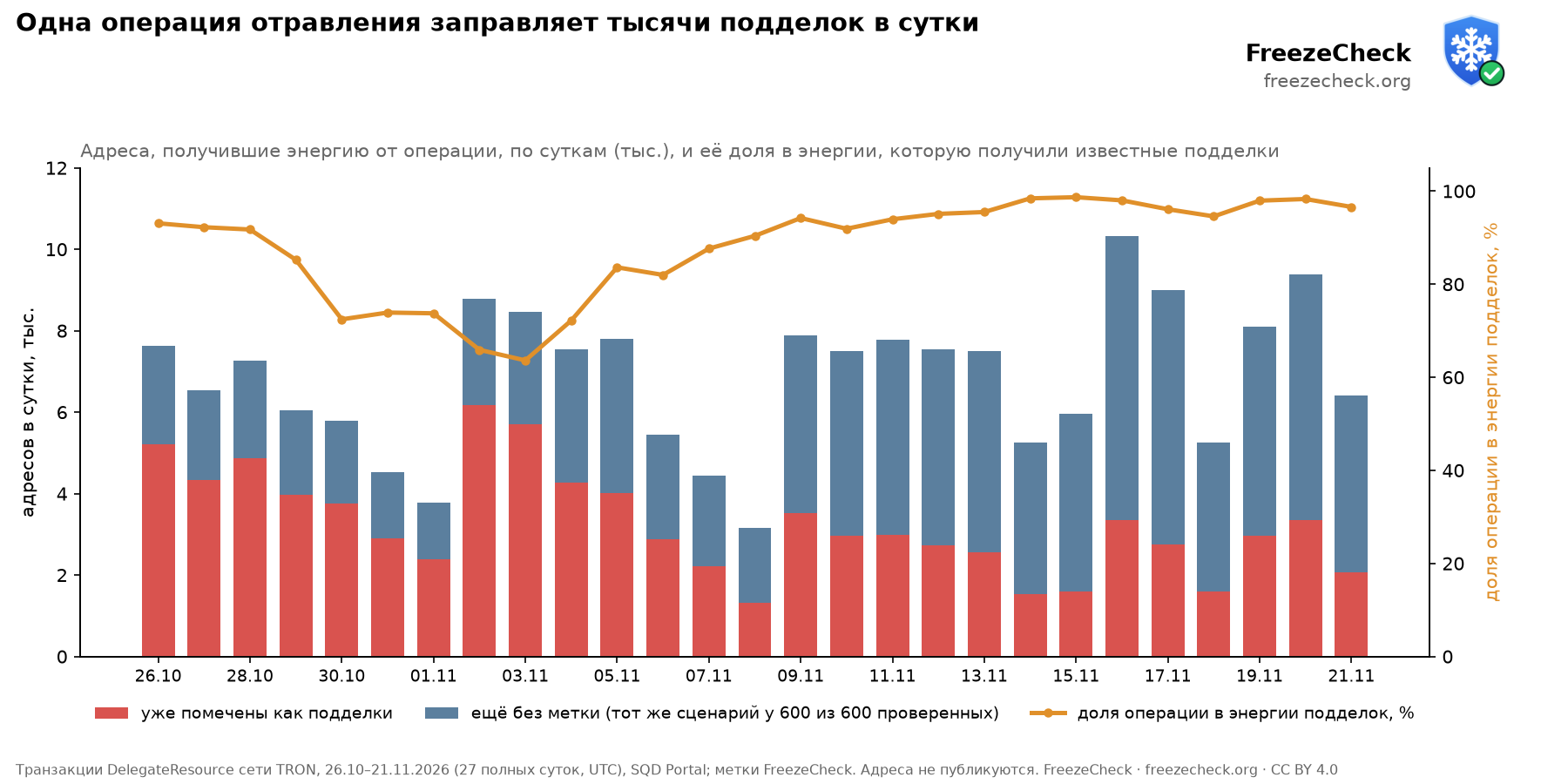
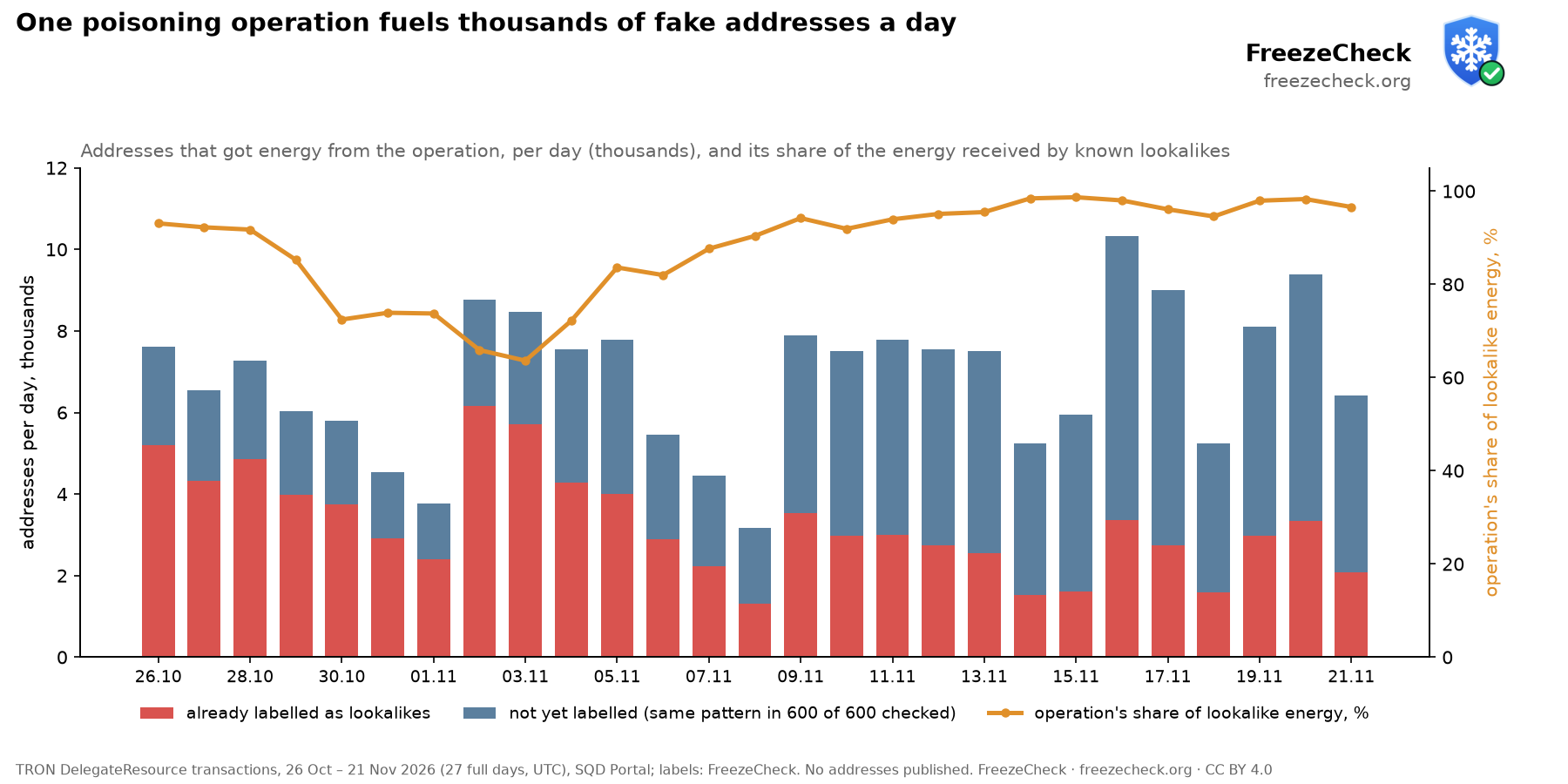
- 129,404 addresses in 28 days. That many different addresses got energy from the operation: 3,200 to 10,300 a day, about 6,900 on average. 47,298 of them (37%) already carry our lookalike labels. The labelled share falls from 68% (October 26) to about 30% (November 21): labels are refreshed weekly and lag behind the chain.
- The rest behave the same way. We checked 400 random unlabelled addresses and 200 labelled ones. All 600 follow one script: the operation activates the address with a 1-sun transfer, delegates energy to it, the address calls the USDT contract, and a few seconds later the energy goes back to the operation. So nearly all of the ~6,900 addresses a day are this operation’s lookalikes, and the “known” share is a lower bound.
- A lookalike burns no TRX at all. In 60 random transactions by the operation’s lookalikes, the USDT call used 64,285 energy each, and all 60 paid an energy fee of 0 TRX. Each refuel is sized for exactly one bait transfer.
- Its own stake covers 1–2%. The operation stakes 900,000 TRX for energy and 500,000 TRX for bandwidth, 1.4 million TRX in total (≈ $0.43M at $0.3037). There was not a single freeze or unfreeze in 28 days; the stake on November 23 is the same. It yields about 8.7 million energy a day. In 28 days the operation handed out 244,023 refuels — 1.6 to 2.3 million TRX (≈ $0.5–0.7M) at the burn price.
- The main fuel is someone else’s stake. On November 23 the operation’s wallet held 19.2 million TRX of stake delegated by other wallets; its limit was 192 million energy a day, with 167 million used. Over 28 days, 99.9% of the stake delegated to the operation came from three wallets (74%, 23.5% and 2% of volume). They are not multi-client providers: each serves from a handful to about a hundred recipients a day. Whether they are the operation’s own network or a wholesale deal cannot be told from the chain.
Comparison: lookalikes, drainers, frozen wallets
A multi-client provider is a wallet that delegates energy to 1,000 or more different recipients in a day. That is what an energy-rental service usually looks like. We name no service, only shares.
| Lookalikes | Drainers | Frozen by Tether | |
|---|---|---|---|
| Got energy in 28 days | 54,750 | 99 | 271 |
| Different providers | 584 | 447 | 180 |
| Top provider’s share | 86% | 56% | 10% |
| Multi-client providers’ share | 13% | 18% | 88% |
Lookalike energy is concentrated in one pair of hands. Addresses frozen by Tether refuel like ordinary users: 88% of their energy comes from multi-client providers. Among the nine large providers that follow the operation (1,000 to 22,600 recipients a day each), labelled lookalikes are 0.56–1.43% of recipients.
Why it matters
- For everyday users. The bait costs the scammer nothing: not a single TRX burned per transfer. So expect more of it. Compare the whole address, not just the first and last characters. Check an address in FreezeCheck Explorer or in @freezecheck_bot before you send.
- For the industry. The operation’s fuel is visible on-chain before any theft: one wallet, thousands of recipients a day, the same script every time. Energy providers, wallets and exchanges can screen energy recipients and addresses that send “dust”.
- For the public debate. Tether can freeze a scammer’s USDT. But the operation’s stake is in TRX, and TRX has no blacklist like USDT does. USDT freezes do not touch the fuel that poisoning runs on.
Method
- Window. TRON blocks 87,421,293 – 88,227,693: October 25 – November 22, 2026, 28 days; 27 full UTC days, October 26 to November 21. Per-day averages use full days.
- Transactions. Every
DelegateResourceContractandUnDelegateResourceContract(energy and bandwidth), plus stake freezes and unfreezes in the window, via SQD Portal in six parallel streams. Aggregates: provider → recipient → day. Network background: ≈ 1.55M energy delegations, ≈ 693,000 recipients and ≈ 3,700 providers a day. - Labels. A “known lookalike” is an address with a FreezeCheck lookalike-scan label (similarity to a target address plus a bait transfer) as of November 22; a “factory” is a wallet that activates and supplies lookalikes. Matched against 13.4 million labelled addresses.
- Shares. “Energy” in shares is the sum of delegation sizes (TRX of stake). It is a weight, not a stake: the same stake is delegated and reclaimed many times, so delegation totals were never added up as stake. The operation’s stake comes from
getaccounton November 22 and 23 and from the absence of freezes and unfreezes in the window. - Price. 1 TRX of stake yields ≈ 9.66 energy a day (180 billion network energy / 18.63 billion TRX of weight, November 22). Burning costs 100 sun per energy unit. The 2.3M TRX upper bound is all delegated energy; the 1.6M TRX lower figure is 244,023 refuels at 64,285 energy each (as in the receipts). TRX price $0.3037 (CoinGecko, November 21, 2026).
- Samples. 400 random unlabelled recipients and 200 labelled ones, from TronGrid transaction history (activator, energy source, USDT call, energy return). 60 random recipients, from the receipts of their USDT call (
energy_usage,energy_fee). - CSV. Per day: network background, how many known lookalikes got energy, the operation’s share, how many addresses the operation fuelled (labelled and not), how many refuels and how much TRX of stake it delegated, the upper burn-price estimate. The file contains no addresses.
Caveats
- Lookalike labels lag behind the chain (weekly scan), so label-based shares are a lower bound. The operation’s share is computed among labelled lookalikes, which are older on average.
- That unlabelled addresses are lookalikes too is inferred from a sample (600 of 600 following the same script), not from checking every address. Similarity to a specific victim cannot be checked from one transfer: a lookalike resembles not the recipient of its own transfer but that recipient’s counterparty.
- The burn-price figure is a range: we did not sum the receipts of all 244,023 refuels.
- A multi-client provider (≥ 1,000 recipients a day) suggests rental; it does not prove it.
- How others’ stake turns into lookalike energy is explained by Stake 2.0 rules: energy a lookalike used moves to the operation when the delegation is reclaimed, and the large limit from three outside wallets covers it. The limit and usage on November 23 are consistent with this, but we did not trace the path transaction by transaction.
- We do not publish the operation’s address or the three wallets’ addresses. There has been no independent review yet.
For media and researchers
Data under CC BY 4.0. Please credit FreezeCheck (freezecheck.org) and link to this page. Daily CSV (no addresses). Charts: English, Russian. Questions: hello@freezecheck.org. Related: map of lookalike factories, losses to address poisoning, 47 uncompleted freezes.