FreezeCheck investigation · TRON multisig
47 Uncompleted Tether Freeze Proposals on TRON: $23.1 Million Moved After the First Signature
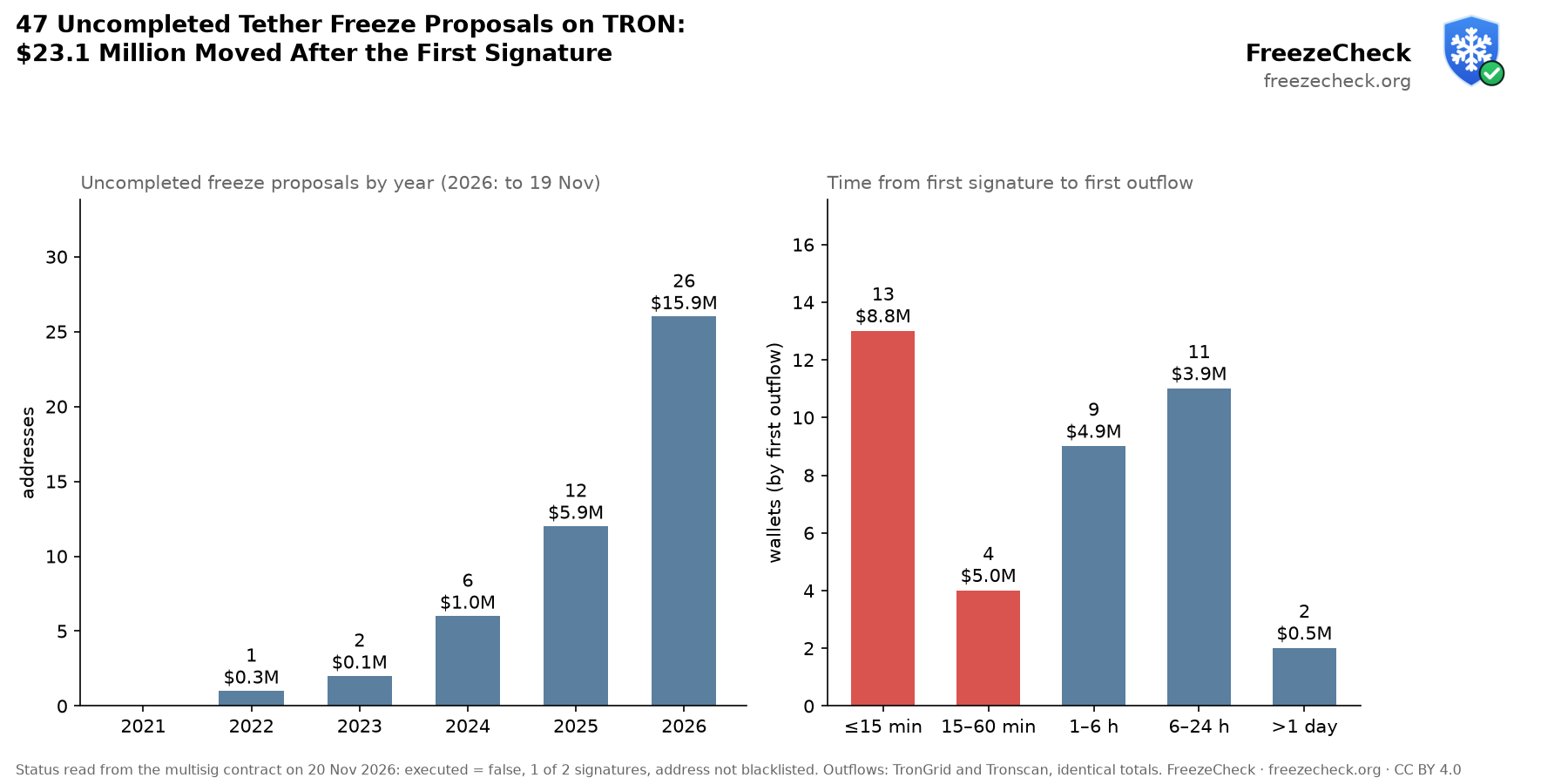
A USDT freeze on TRON needs two signatures in Tether's 2-of-3 multisig. FreezeCheck read every proposal in that multisig since February 2021 and found 47 wallets where the first signature was given, the target became public, and the second signature has not come as of November 20, 2026. None of the 47 is frozen. 39 of them sent out 23.1 million USDT after the first signature.
Tether's response. Tether received our request for comment on November 20, 2026; no reply as of publication.
A freeze proposal is a public transaction: anyone can decode the target address. Until the second owner confirms, the wallet can still send USDT.
All 47 wallets: how fast the money moved
Each dot is a wallet with an uncompleted freeze proposal. Left to right: minutes from the first signature to the first outgoing USDT transfer (log scale). Size: USDT sent out. Click a dot to open the wallet in the Explorer.
The ten largest outflows
| Wallet | Proposal | First outflow | USDT out |
|---|---|---|---|
TLs9Y5…774Xrh | 4 Nov 2026 | 41 min after | 4,574,511 |
TWfUk1…PbL4uJ | 4 Nov 2026 | 9 min after | 3,059,005 |
TWxHMD…jZkA5U | 10 Jul 2025 | 9 min after | 2,695,711 |
TXLx8C…BRPCyk | 31 Mar 2026 | 1.9 h after | 1,509,025 |
TPU7u9…479dzj | 3 Jun 2025 | 7.6 h after | 1,043,719 |
TMoH36…UEpZLc | 29 Oct 2025 | 3.4 h after | 1,000,001 |
TBjuC5…X8qYh9 | 20 Jan 2026 | 8.0 h after | 770,000 |
TP7962…rEr3tT | 25 Jan 2026 | 1.5 h after | 550,000 |
TSVKUw…rfe5Nw | 25 Jan 2026 | 1.5 h after | 500,000 |
TCLtCf…F9ot5c | 28 Apr 2026 | 11.3 h after | 460,295 |
All 47 with transaction hashes: CSV
How a freeze is supposed to work
The USDT contract on TRON is owned by the multisig wallet TBPxhVAsuzoFnKyXtc1o2UySEydPHgATto. To freeze an address, one owner submits addBlackList(address); this first signature is a public transaction, and anyone can decode the target. A second owner confirms, and only then is the address frozen. In our earlier study, the signing window, half of all freezes executed within 9.7 minutes of the first signature. The 47 proposals in this study are the ones where the second step had not happened by November 20, 2026.
Key findings
- 47 wallets, first signature only. FreezeCheck read all 11,958 transactions ever proposed in the multisig. For 47 distinct addresses the
addBlackListproposal has 1 confirmation of the 2 required,executedis false, andisBlackListedreturns false today. We read these three values directly from the contracts on November 20, 2026. - $23.1 million left after the first signature. 39 of the 47 wallets sent out 23,120,376 USDT after the proposal became public. FreezeCheck counted it twice, from a TRON node (TronGrid) and from the Tronscan index; the totals match to the dollar.
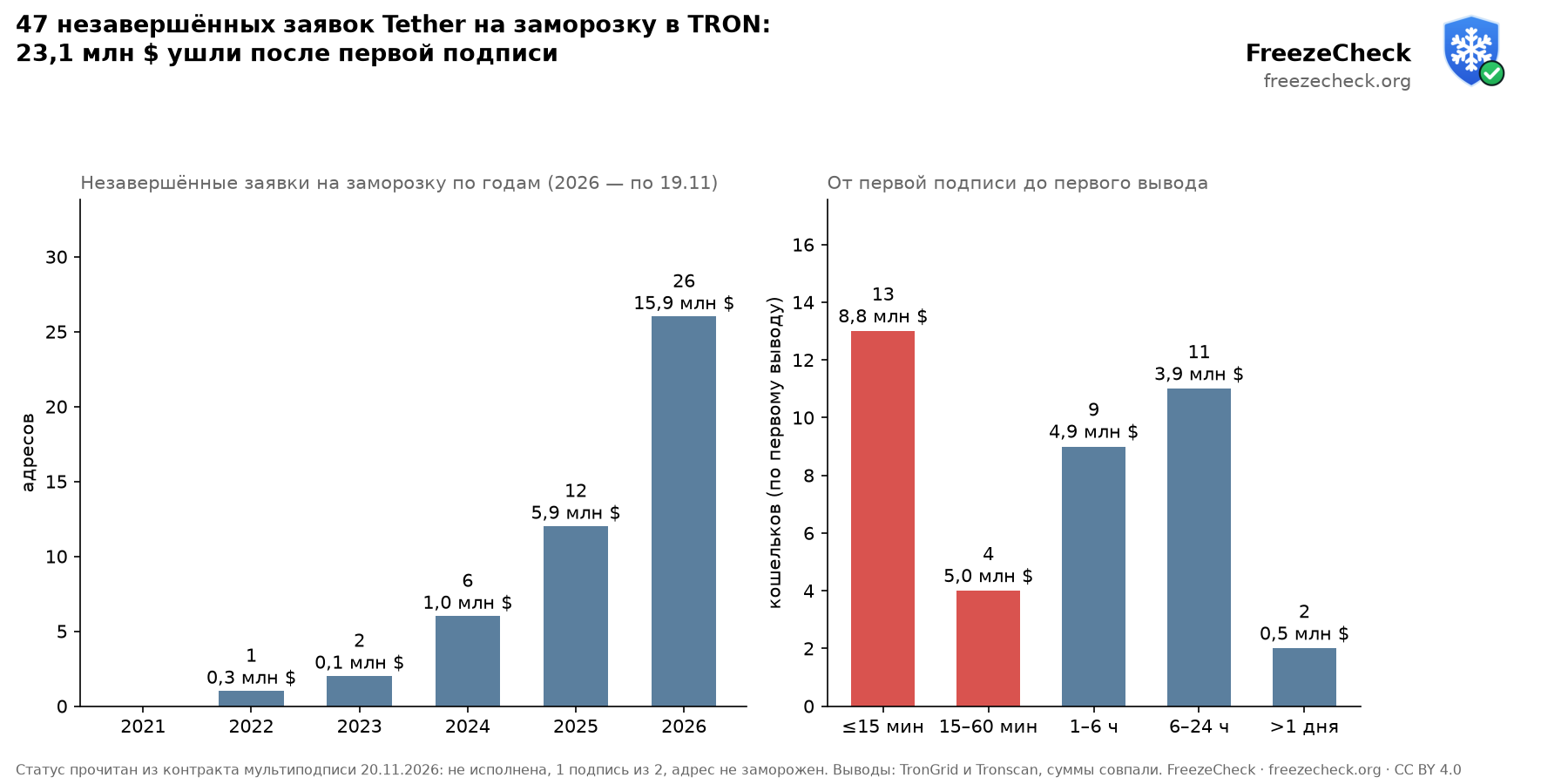
- Most of it left fast. 13 wallets made their first outgoing transfer within 15 minutes of the first signature (these wallets sent out 8.8 million USDT in total), 17 within an hour (13.8 million). Times are measured in seconds from the block time of the proposal.
- Batches moved within minutes. On June 1, 2026 Tether proposed freezing four wallets at once; all four made their first transfer 3.7–6.3 minutes later and sent 1.07 million USDT, almost all of it to one address. On July 2, 2026 Tether proposed seven wallets; six of them sent 1.71 million USDT, almost all to one address, starting 5.2–8.7 minutes after the proposal; the seventh had no outflow. On November 4, 2026 three wallets moved 7.9 million USDT, with first transfers 5.4–41.2 minutes after the proposal. None of these proposals has a second signature.
- More cases in absolute numbers. 0 cases in 2021, 1 in 2022, 2 in 2023, 6 in 2024, 12 in 2025 and 26 in 2026 (to November 19). The multisig itself became much busier: it handled 116, 573 and 360 proposals of all kinds in 2021–2023, against 1,404, 4,273 and 5,232 in 2024–2026. The count of uncompleted proposals grew; we make no claim that a single proposal became more likely to stay unsigned.
- Main recipients. For each of the 39 wallets we took the address that received the most USDT from it. These are 29 distinct addresses; 2 of them are frozen today. We did not trace the money further. You can follow every wallet and its recipients in the FreezeCheck Explorer: the CSV has a direct link for each.
The three largest cases
- TLs9Y5…774Xrh: proposal on November 4, 2026; 4.57 million USDT sent out in one transfer 41 minutes later, to an address that FreezeCheck links to an earlier Tether freeze.
- TWfUk1…PbL4uJ: same batch; 3.06 million USDT out in one transfer 9 minutes after the proposal.
- TWxHMD…CvjZkA5U: proposal on July 10, 2025; first transfer 9 minutes later; 2.70 million USDT sent out in total over the following months (0.65 million within the first hour).
Why it matters
- For victims and investigators. A freeze proposal is often the result of a police request or a victim's report. A first signature without a second one announces the freeze but does not stop the money.
- For exchanges and payment services. These 47 wallets are not on the blacklist, so a blacklist-only check passes them. FreezeCheck shows the proposal history and the risk of every TRON address: check any address in the Explorer or in @freezecheck_bot.
- For the public record. In a June 4, 2026 letter, U.S. Senator Richard Blumenthal asked Tether: “Has Tether ever failed or declined to blacklist a wallet address or terminate a client where it had reason to believe that the wallet or client was engaged in illicit finance?” (letter, PDF; press release). This dataset does not answer why each proposal stopped; it shows, from the chain, where a freeze was started and not completed.
Method
- Proposals. All
Submission,Execution,ExecutionFailureandRevocationevents of the multisig from its first proposal (February 9, 2021) to the check on November 20, 2026, 17:44 UTC: 11,958 proposals, 11,825 executions. For every proposal without anExecutionevent, FreezeCheck calledtransactions(id),getConfirmationCount(id)and, foraddBlackList, the USDT contract'sisBlackListed(address). - Included.
addBlackListproposals addressed to the USDT contract, not executed, with the target not blacklisted on November 20, 2026, submitted before November 20, 2026; one row per address (earliest proposal). The CSV gives each proposal's exact time (UTC, to the second), block number and transaction hash. - Excluded. The TRON zero address (5 proposals); 3 proposals whose only signature was revoked (one target is an exchange deposit address); 1 proposal submitted on November 20, 2026; 37 unexecuted proposals (33 addresses) whose target was frozen through another proposal; 2 repeat proposals for an address already in the list.
- Outflows. USDT
Transferevents from each address from the exact proposal time (milliseconds), read from TronGrid and checked against Tronscan. Approvals are not counted. Totals from both sources are identical (23,120,376 USDT). One transfer of 275,800 USDT went from one listed wallet to another (November 4 batch); net of it, 22.8 million USDT left the 47 wallets. - Recipients. Main recipient = the address that received the most USDT from the wallet. Matched against FreezeCheck's label database (88M+ labeled TRON addresses); frozen status read from the USDT contract at the check time.
- Reproducibility. The whole pipeline is one script (
reproduce.py) that re-fetches the multisig events, contract state and transfers from public TronGrid endpoints and rebuilds the CSV; a second script (crosscheck_tronscan.py) repeats the outflow totals on Tronscan. Both, with the raw data they produced, are available on request.
What to keep in mind
- "Not executed" means not executed as of November 20, 2026, 17:44 UTC. Tether sometimes confirms proposals late: 568 of 11,825 executions in the multisig's history came more than 14 days after the proposal. Any of the 47 could still be signed. The money that already left would not be affected. We re-read the contracts on November 22, 2026, before publication: none of the 47 had been frozen or had received a second signature, and no new outflows had appeared.
- The chain does not show why a second signature did not come. A proposal may have been withdrawn informally, made in error, or overtaken by events. We make no claim about intent.
- A transfer after the proposal is not proof that its sender saw the proposal. The timing in the batch cases is shown so readers can judge.
- Three proposals (November 4, 2026; 7.9 million USDT out) are 16 days old. Without them: 44 wallets, 15.2 million USDT.
For media and researchers
Data under CC BY 4.0. Please credit FreezeCheck (freezecheck.org) and link to this page. CSV with all 47 proposals (also on Zenodo, DOI 10.5281/zenodo.24447105): proposal ID, exact time and block, address, signatures, outflow after the proposal, minutes to the first outflow, main recipient and its status, proposal transaction hash, check time, and a link to each address in the FreezeCheck Explorer. Charts in English and Russian. Questions: hello@freezecheck.org. Related FreezeCheck research: the signing window, who Tether freezes and who it doesn't, Tether unfreezes.